Citation:
Huping SHANG. China’s Appeal of “Governance” and the Dilemma of Current Domestic Governance Research[J]. Academic Monthly, 2019, 51(5): 72-87.

China’s Appeal of “Governance” and the Dilemma of Current Domestic Governance Research
-
Abstract
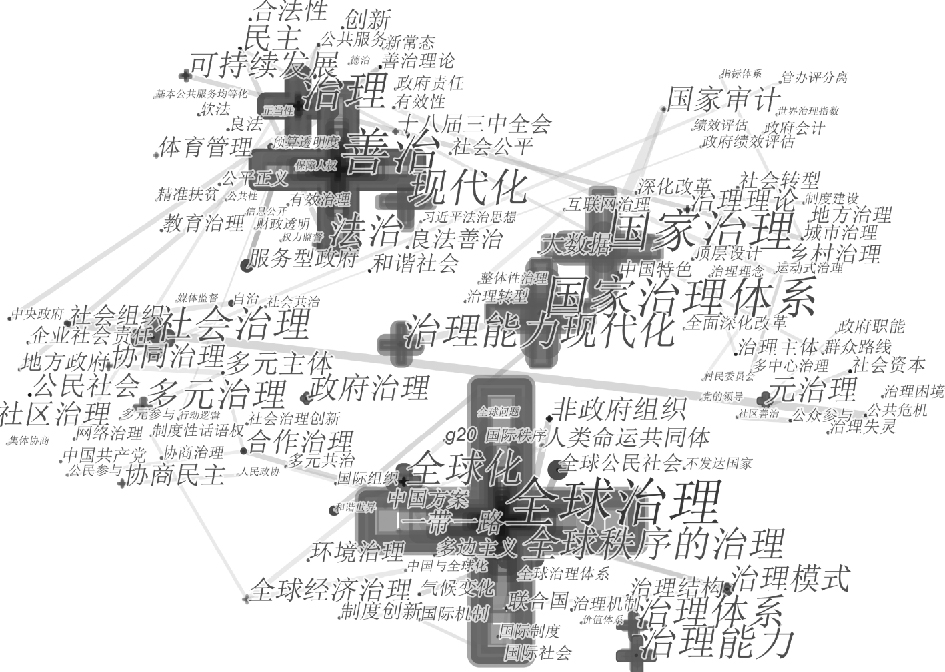
Advancing governance research cannot only introduce a " world research fashion”, but also build " core technology” on the basis of understanding China’s demands. However, it is drawn from the results of CSSCI database text mining that the current governance research in China mainly focuses on good governance, multiple governance, global governance and national governance. The former three researches mainly speared the Western discourse system while the latter infinitely expands the extension of national governance and blurs its connotation, making it an " omnipotent liberal arts research” that almost involves all humanities and social science sub-disciplines. It is necessary to combine governance research with the history of China and current national conditions to change the dilemma of current governance research. Utilizing the governance research to overcome the " power country autism”, " power country alienation” and " the atomic disease of the people” as well as applying it into the implementation of socialist system advantages. Meanwhile, constructing a scientific and operational governance theory system that is beneficial to seize discourse power in the global governance research.
-

-
References
-
Access
-
-
[1]
SUO Liming
, WEI He'ning
. Platform Transition: The Re-Evolution of Network Governance Model. Academic Monthly,
2026, 58(7): 90-103.
-
[2]
ZHOU Mujun
. Between Theory and Empirical Facts: Habermas and the Sociological Debate on the Public Sphere. Academic Monthly,
2026, 58(8): 157-170.
-
[3]
XIE Yue
. How State Capacity Is Generated in Practice——A Dynamic Equilibrium Model of Governance. Academic Monthly,
2026, 58(8): 106-117.
-
[4]
ZHAO Lin
, ZHANG Boyu
, LIANG Hua
. The Relationship Between Monopoly and Innovation in Information Product Markets——A Growth Network Perspective. Academic Monthly,
2026, 58(7): 64-76.
-
[5]
LU Mingjun
. Simulacra, Pattern Recognition, and Computational Formalism——Reflections on the Application of AI in Artistic Practice and Art History Research. Academic Monthly,
2026, 58(8): 41-55.
-
[6]
LIAO Han
. Popular Religion and the Formation of Local Culture——Research on the Belief in Ge Xian'gong in Northeastern Jiangxi since the Song and Yuan Dynasties. Academic Monthly,
2026, 58(7): 195-205.
-
[7]
LIN Xifen
, FU Zhangyi
. How Does Public Trust in the Judiciary Shape Acceptability of Judges' AI-assisted Adjudications——An Empirical Study Based on Questionnaire Data. Academic Monthly,
2026, 58(8): 133-144.
-
[8]
LI Ting
. From The Reproductive Institution to the Fertility Transition in Contemporary China. Academic Monthly,
2026, 58(7): 143-156.
-
[9]
ZHANG Yi
. Cognitive Transformation in Historical Research in the Age of AI——“Fluency-Induced Occlusion” in LLM-Assisted Reading of Diplomatic Manuscripts. Academic Monthly,
2026, 58(8): 29-40.
-
[10]
WEN Jun
. From Technical Tokens to Social Tokens: the Ontological Construction of Token Sociology. Academic Monthly,
2026, 58(8): 145-156.
-
[11]
RAN Gaoran
. The Evolution and Game of Property Systems——On the Paradigm Choice for Data Property. Academic Monthly,
2026, 58(7): 117-128.
-
[12]
SHEN Yifei
. Theoretical Genealogies of the Emotional Economy and the Chinese Context. Academic Monthly,
2026, 58(7): 129-142.
-
[13]
YU Jianxing
, LIU Yuxuan
. Beyond the Outside Observer: Repositioning the Social Sciences in the Era of Large Language Models. Academic Monthly,
2026, 58(7): 77-89.
-
[14]
NI Liangkang
. The Philosophy of History of “New Idealism” after Hegel: Neo-Hegelianism. Academic Monthly,
2026, 58(7): 12-22.
-
[15]
LIN Shangli
. China's Mission in Constructing Original Theories and Its Methodological Foundation. Academic Monthly,
2026, 58(7): 5-11.
-
[16]
LIU Wei
. Several Important Theoretical Issues Needing Further Clarification for the Growth and Expansion of the Private Economy. Academic Monthly,
2026, 58(7): 41-53.
-
-


 沪公网安备 31010102003103号
 DownLoad: