Welcome to visit ACADEMIC MONTHLY,Today is

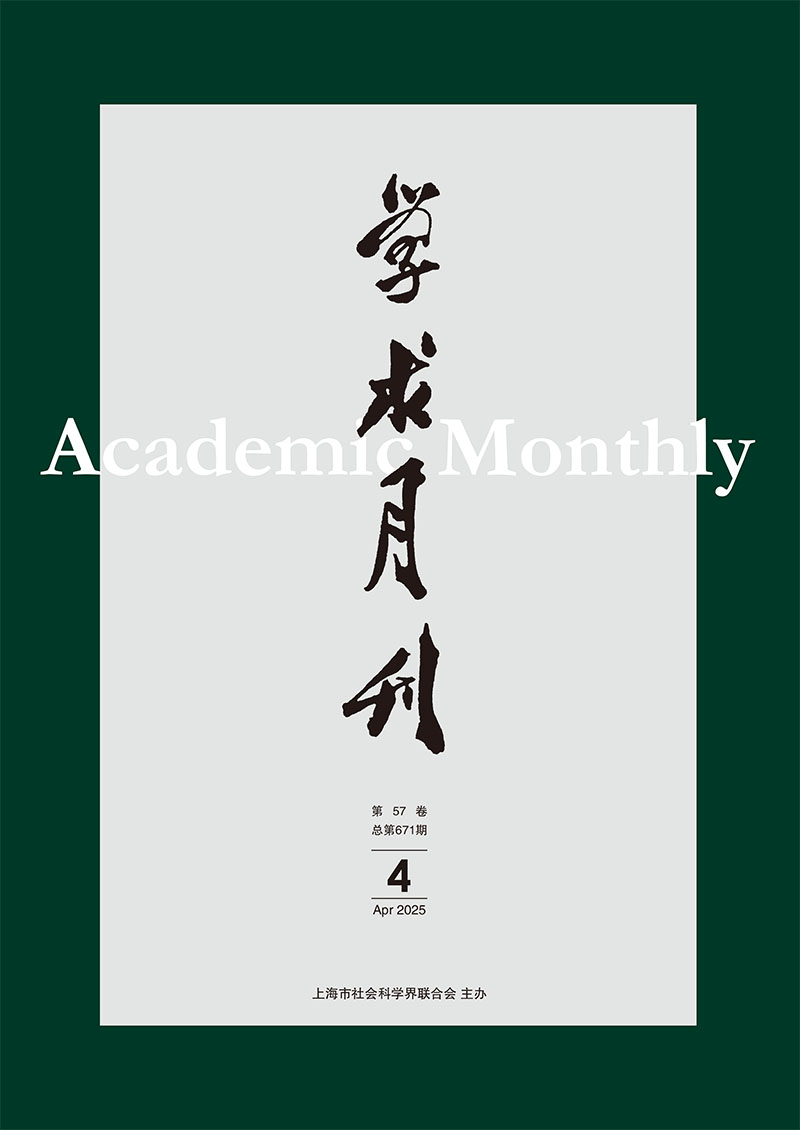
Volume 57 Issue 4
April 2025
Article Contents

Citation: HE Ping. Studies and Writings of Academic History of Marxist Philosophy in New China[J]. Academic Monthly, 2025, 57(4): 5-17. shu

Studies and Writings of Academic History of Marxist Philosophy in New China

  • The subject of academic creation of Marxist philosophy in new China is the academic world of Marxist philosophy in new China.From 1950s to 1970s,this academic world chiefly compiled China’s textbooks of Marxist philosophical principles,and made critical thinking on the Soviet Union’s textbook system,thus opened China’s era of academic studies on Marxist philosophy.In 1980s,four principles had been formed in academic enlightenment:(1) distinguishing between political ideas enlightenment and academic enlightenment,and seek the ways of academic development of Marxist philosophy in new China through academic enlightenment;(2) finding the characteristics of the academic studies in the discussions when compiling the textbooks of principles in 1950s;(3) the object of this studies on academic history is the history of academic creation of Marxist philosophy in new China;(4) in such studies,a world-view should be established on the development of Marxist philosophy.Since 1990s,the academic world has made the Sinicize of Marxist philosophy as its writing paradigm,narrated the forming and development of the academic ideas of China’s Marxist philosophy,and proposed a historical method in writing the academic history of China’s Marxist philosophy.This method,in writing such an academic history,has applied a non-linear mode of thinking to draw a complicated schema of the academic development of Marxist philosophy in China,and revealed an innate mechanism of academic revolution to find out a future trend for academic innovation of Marxist philosophy in China.
  • 加载中
    1. [1]

      HE Jun . Confucius's Paradigm Shaping of Chinese Philosophy. Academic Monthly, 2026, 58(8): 56-69.

    2. [2]

      NI Liangkang . The Philosophy of History of “New Idealism” after Hegel: Neo-Hegelianism. Academic Monthly, 2026, 58(7): 12-22.

    3. [3]

      LU Mingjun . Simulacra, Pattern Recognition, and Computational Formalism——Reflections on the Application of AI in Artistic Practice and Art History Research. Academic Monthly, 2026, 58(8): 41-55.

    4. [4]

      ZHANG Yi . Cognitive Transformation in Historical Research in the Age of AI——“Fluency-Induced Occlusion” in LLM-Assisted Reading of Diplomatic Manuscripts. Academic Monthly, 2026, 58(8): 29-40.

    5. [5]

      LI Ting . From The Reproductive Institution to the Fertility Transition in Contemporary China. Academic Monthly, 2026, 58(7): 143-156.

    6. [6]

      SHEN Yifei . Theoretical Genealogies of the Emotional Economy and the Chinese Context. Academic Monthly, 2026, 58(7): 129-142.

    7. [7]

      LIN Shangli . China's Mission in Constructing Original Theories and Its Methodological Foundation. Academic Monthly, 2026, 58(7): 5-11.

    8. [8]

      ZHAO Lin ,  ZHANG Boyu ,  LIANG Hua . The Relationship Between Monopoly and Innovation in Information Product Markets——A Growth Network Perspective. Academic Monthly, 2026, 58(7): 64-76.

    9. [9]

      LIAO Han . Popular Religion and the Formation of Local Culture——Research on the Belief in Ge Xian'gong in Northeastern Jiangxi since the Song and Yuan Dynasties. Academic Monthly, 2026, 58(7): 195-205.

    10. [10]

      LIN Xifen ,  FU Zhangyi . How Does Public Trust in the Judiciary Shape Acceptability of Judges' AI-assisted Adjudications——An Empirical Study Based on Questionnaire Data. Academic Monthly, 2026, 58(8): 133-144.

    11. [11]

      ZHOU Mujun . Between Theory and Empirical Facts: Habermas and the Sociological Debate on the Public Sphere. Academic Monthly, 2026, 58(8): 157-170.

    12. [12]

      XU Xiangdong . Consciousness and The Moral Status of AI Agents. Academic Monthly, 2026, 58(8): 5-15.

    13. [13]

      RAN Gaoran . The Evolution and Game of Property Systems——On the Paradigm Choice for Data Property. Academic Monthly, 2026, 58(7): 117-128.

    14. [14]

      CHEN Yinchi ,  WU Siqi . Interaction and Integration between Buddhist and Daoist Hagiographies in Medieval China. Academic Monthly, 2026, 58(7): 157-169.

    15. [15]

      LI Yushuan . New Changes and Causes of the Poetry Style of Monks in the Ming Dynasty. Academic Monthly, 2026, 58(7): 170-180.

    16. [16]

      YING Qi . Hegel's Conception of Reconciliation and the Quarrel of the Ancients and the Moderns. Academic Monthly, 2026, 58(7): 23-31.

    17. [17]

      QIN Zhongliang . Historical Views and Historical Facts: The Evolution of Perceptions of Fanzhen since the Song Dynasty. Academic Monthly, 2026, 58(7): 181-194.

    18. [18]

      SUO Liming ,  WEI He'ning . Platform Transition: The Re-Evolution of Network Governance Model. Academic Monthly, 2026, 58(7): 90-103.

    19. [19]

      WANG Gang . Viewing the Cultural Intent of the “Xueheng School” from Hu Xiansu's Teachers and Friends's Group. Academic Monthly, 2026, 58(7): 206-216.

    20. [20]

      HU Jun . Three Dimensions of Aesthetic Value from the Perspective of Neuroaesthetics——On the Essence of Beauty and Other Issues. Academic Monthly, 2026, 58(8): 184-194.

Article Metrics

Article views: 2543 Times PDF downloads: 173 Times Cited by: 0 Times

Metrics
  • PDF Downloads(173)
  • Abstract views(2543)
  • HTML views(561)
  • Latest
  • Most Read
  • Most Cited
        通讯作者: 陈斌, bchen63@163.com
        • 1. 

          沈阳化工大学材料科学与工程学院 沈阳 110142

        1. 本站搜索
        2. 百度学术搜索
        3. 万方数据库搜索
        4. CNKI搜索

        Studies and Writings of Academic History of Marxist Philosophy in New China

        Abstract: The subject of academic creation of Marxist philosophy in new China is the academic world of Marxist philosophy in new China.From 1950s to 1970s,this academic world chiefly compiled China’s textbooks of Marxist philosophical principles,and made critical thinking on the Soviet Union’s textbook system,thus opened China’s era of academic studies on Marxist philosophy.In 1980s,four principles had been formed in academic enlightenment:(1) distinguishing between political ideas enlightenment and academic enlightenment,and seek the ways of academic development of Marxist philosophy in new China through academic enlightenment;(2) finding the characteristics of the academic studies in the discussions when compiling the textbooks of principles in 1950s;(3) the object of this studies on academic history is the history of academic creation of Marxist philosophy in new China;(4) in such studies,a world-view should be established on the development of Marxist philosophy.Since 1990s,the academic world has made the Sinicize of Marxist philosophy as its writing paradigm,narrated the forming and development of the academic ideas of China’s Marxist philosophy,and proposed a historical method in writing the academic history of China’s Marxist philosophy.This method,in writing such an academic history,has applied a non-linear mode of thinking to draw a complicated schema of the academic development of Marxist philosophy in China,and revealed an innate mechanism of academic revolution to find out a future trend for academic innovation of Marxist philosophy in China.

          HTML

        Relative (20)

        目录

        /

        DownLoad:  Full-Size Img  PowerPoint
        Return
